

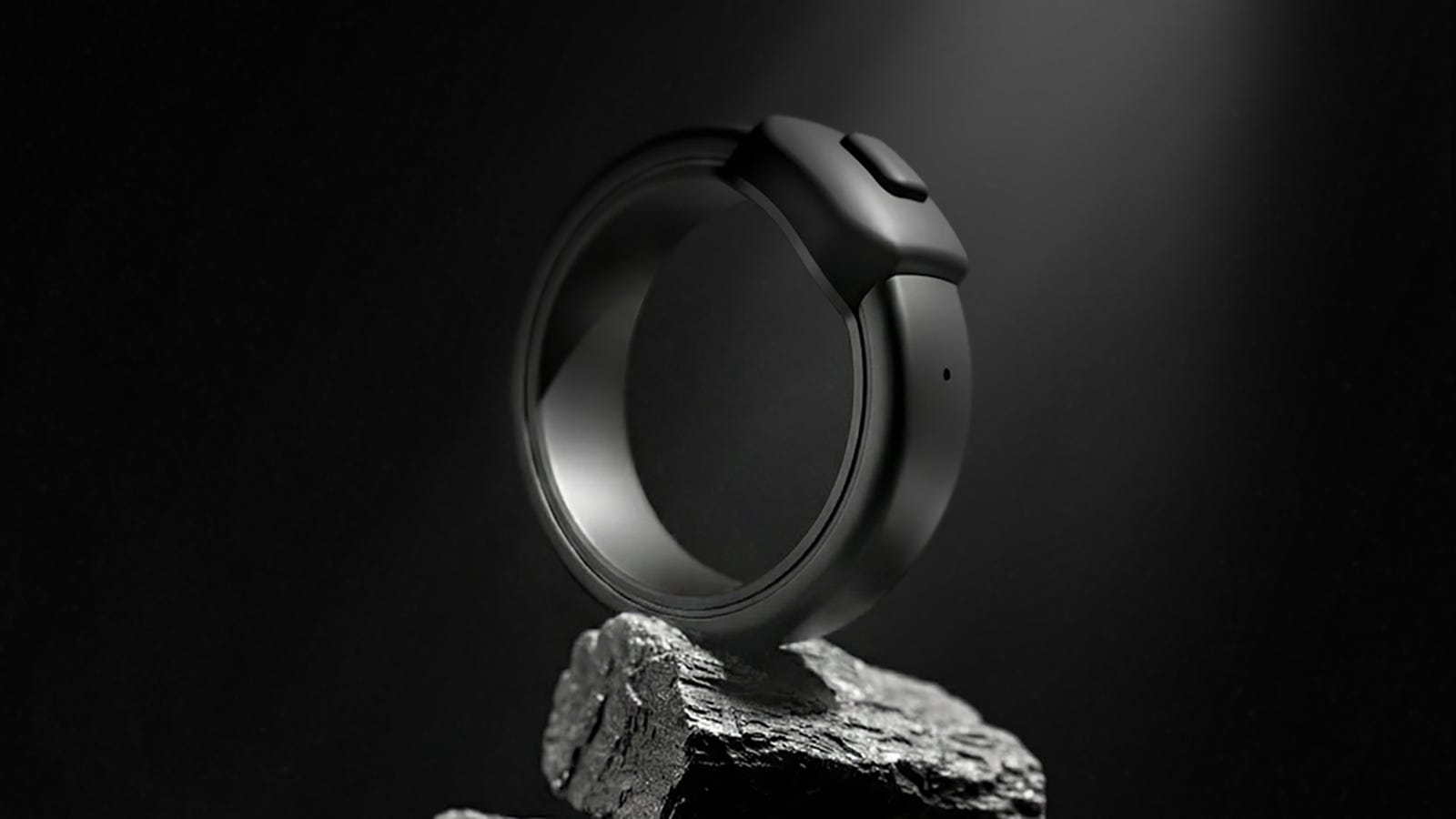
Pebble launched a ring today.
Remember Pebble? Founded by Eric Migicovsky in 2012, Pebble Technology Corp. pioneered crowdfunded smartwatches with a record-setting Kickstarter campaign. The company transferred its software assets, some intellectual property and most of its employees to Fitbit in 2016. Google then acquired Fitbit in 2021.
Migicovsky relaunched the Pebble brand in 2025, announcing new PebbleOS‑based watches under his company Core Devices in March, then started using the Pebble brand for those watches after regaining the trademark in July.
The ring, called the Index 01, records audio. (“Index” refers to the finger you wear it on.) To use it, you press its button with your thumb and talk into it. Your words then become captured as notes, or sent as a text.
Pebble offers it in three finishes, described as polished silver, polished gold and matte black, in sizes 6 through 13. The main visual and functional feature is a single side button with a pronounced click, surrounded by silicone rubber, that activates a tiny microphone in the ring. There is no display, no vibration motor, no LEDs for notifications and no health sensors.
When you record a note, the ring creates an audio file stored on the ring. It then encrypts the audio file and transfers it to your phone via Bluetooth, where the app uses built-in LLM AI to process the audio. Everything happens on ring and phone, not in the cloud. It works the same whether your phone is connected or offline.
Here’s the craziest part: The ring cannot be recharged. When the battery dies after roughly two years, you send it back to the company for recycling. (This engineering choice enables the ring to be smaller.)
The ring is also “open,” according to Migicovsky, so it can be customized.
Pre-orders start today here at a price of $75, and people buying after its ship date will pay $99. The company is looking to ship in March.
The existence of this product, and the appeal of it (the Index 01 isn’t the first watch to focus on capturing voice notes) makes me think that the “ring” form factor is really here to stay.
There are many smart rings on the market, including the Oura Ring, Samsung Galaxy Ring, Ultrahuman Ring Air, RingConn Smart Ring, Evie Ring by Movano, Circular Ring, Hey Ring, McLear RingPay, and various smaller-brand fitness or payment rings from makers such as Amazfit.
Major companies, including Apple, Meta, Huawei, and FIN Robotics, all have extensive patents for smart rings that enable gesture control of AR or VR glasses or goggles.
I would guess that around half the people I know (I know a lot of gadget fans) wear some kind of smart ring, usually an Oura Ring.
It seems to me that a product like this — under $100, no charging, private — could accelerate the mainstream acceptance of smart rings. I’m definitely getting one.
It’s also part of the long disappearing act of smartphone functions into wearables. And this is what will kill smartphones. The features and functions will migrate to glasses, watches, and, so it appears, rings.
The other interesting aspect of smart rings as a general product category is that we have 10 fingers. It’s only a matter of time before people wear multiple smart rings, one for voice recording, another for fitness, and yet another for gesture control of glasses (all in addition, of course, to a wedding ring).

This is a fascinating pivot for Pebble, and I appreciate how cleanly they’ve committed to a single, private function rather than trying to mimic a miniature smartwatch. A sub-$100 on-device recorder with no cloud dependency feels like exactly the kind of quiet innovation that pushes wearables deeper into everyday use. If this really is the point where ring-based interfaces begin replacing pieces of the phone, Pebble may have just stepped back into the conversation at exactly the right moment.
I think you have an overblown idea of how much everyday people want gadgets. Look around on the streets, as many people use their phones without headphones as do, apple watches may be slowly becoming ubiquitous but I do not see a world where the "normies" are going to want to have to keep track of, and for most devices charge, headphones, glasses, rings, and god knows what else. One of the main reasons, IMO, that smartphones have become what they are is because the are a multifunction tool. Break all the usefulness into multiple devices and I think you lose people.